Rhumb Lines (Loxodromes) vs Great Circles
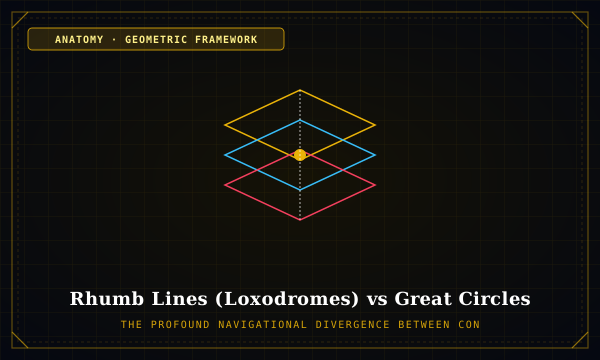
"The profound navigational divergence between constant compass bearings and shortest geodesic paths"
A rhumb line (loxodrome) is a path of constant compass bearing that spirals toward the poles on a sphere. A Great Circle (orthodrome) is the shortest distance between two points on a sphere, but requires constantly adjusting your compass course.
Core Mechanism & Structure
Loxodromic spiral: $\tan \alpha = \frac{\cos \phi \, d\lambda}{d\phi}$. Great circle spherical arc distance: $\arccos(\sin \phi_1 \sin \phi_2 + \cos \phi_1 \cos \phi_2 \cos \Delta \lambda)$.
Historical Evolution & Standardization
Pedro Nunes discovered that compass courses spiral toward the pole (1537) -> Mercator created his projection to make loxodromes straight lines (1569) -> Radio navigation and GPS enabled automated Great Circle flight tracking.
Critical Semiotic Analysis
"Mercator maps fool passengers into thinking flights from New York to London flying over Greenland or the Arctic are taking a bizarre detour, when they are following the true shortest great-circle geodesic."