Return to Laboratory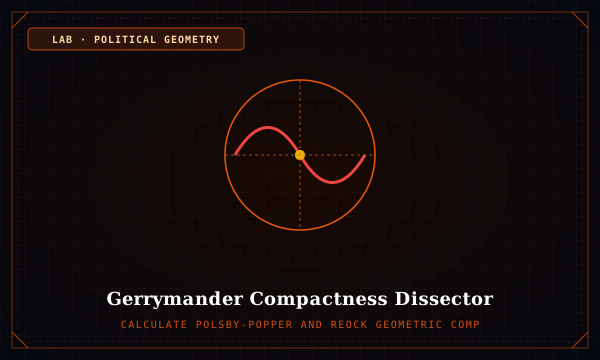
Category: Political Geometry
Gerrymander Compactness Dissector
LAB INSTRUMENT SPECIMEN · GERRYMANDER-DISSECTOR
"Calculate Polsby-Popper and Reock geometric compactness metrics for custom electoral polygons"
Test custom polygon shapes against standard legal gerrymandering compactness tests to identify intentional spatial distortion in voting districts.
POLSBY-POPPER COMPACTNESS DISSECTOR
FORMULA: 4πA / P²POLSBY-POPPER COMPACTNESS SCORE:
1.000
Area: 314.15 km² · Perimeter: 62.83 km
Standard Compactness
Score demonstrates natural convex geometry.
Operating Instructions
- Select a preset district geometry (e.g. Circle, Square, Maryland 3rd District 'Broken Winged Pterodactyl', North Carolina 12th District).
- Or adjust the perimeter complexity and indentation sliders.
- Review the computed Polsby-Popper isoperimetric quotient ($PP = 4\pi A / P^2$) and Reock minimum bounding circle ratio.
- Compare scores against the legal compactness threshold ($PP < 0.15$ indicates severe geometric irregularity).
Mathematical & Geodetic Theory
The Polsby-Popper test measures the ratio of the district area to the area of a circle with the same perimeter: $PP = \frac{4\pi \cdot \text{Area}}{\text{Perimeter}^2}$. A perfect circle scores 1.0; convoluted gerrymandered corridors score near 0.0.
Mathematical Baseline: Polsby, D. D., & Popper, R. D. (1991)