Tissot Distortion Crucible
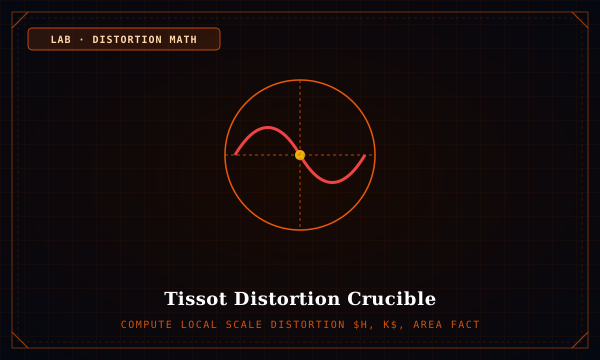
"Compute local scale distortion $h, k$, area factor $hk$, and angular shear $2\theta'$ across 14 map projections"
Select any projection and latitude to calculate Nicolas Auguste Tissot's infinitesimal deformation ellipse, visualizing the trade-offs between conformality and equivalence.
Mercator Projection (1569)
Inventor: Gerardus Mercator · Family: Cylindrical
One round Earth.
Mercator
Gall–Peters
"When co-opted into classrooms and wall atlases, Mercator visually inflates imperial powers in North America and Europe while drastically shrinking the African continent, South America, and the equatorial belt."
h = k = \sec \phiFull Mathematical DossierOperating Instructions
- Select a target projection from the dropdown menu (e.g. Mercator, Gall-Peters, Robinson, Winkel Tripel).
- Adjust the latitude slider from 0° (Equator) to 85° (Polar).
- Observe the Tissot ellipse deform in real time, comparing local meridian scale ($h$) and parallel scale ($k$).
- Inspect the calculated Area Factor ($hk$) and Maximum Angular Deformation ($2\theta'$).
Mathematical & Geodetic Theory
Tissot's theorem proves that an infinitesimal circle on a sphere is transformed into an ellipse on a map projection with semi-major axis $a$ and semi-minor axis $b$. The area scale is $a \cdot b = hk \cos \theta'$, and maximum angular deformation is $\sin \theta' = \frac{a - b}{a + b}$.