Return to Projection Lab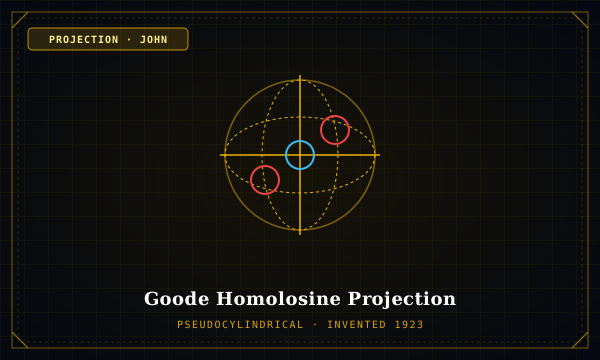
Pseudocylindrical Family·Inventor: John Paul Goode·Year: 1923
Goode Homolosine Projection
MATHEMATICAL SPECIMEN · GOODE-HOMOLOSINE
"Equal-area interrupted hybrid joining Sinusoidal at the equator with Mollweide in the polar zones"
Goode combined the Sinusoidal projection (between 40°44'N and 40°44'S) with the Mollweide projection for higher latitudes, interrupting the ocean basins to allow each major continental landmass to be centered on its own local meridian.
Forward Mathematical Formulation
X-COORDINATE:
\text{Sinusoidal below } 40^\circ 44', \quad \text{Mollweide above } 40^\circ 44'Y-COORDINATE:
Coincident parallels at } \phi = \pm 40^\circ 44'12''DIFFERENTIAL METRIC:
Equal-area across all segments (h \cdot k = 1)Cartographic Application & Critique
Primary Applications: Rand McNally Goode's World Atlas, Global distribution of climate, agriculture, and forestry.
Critical Analysis: Known colloquially as the 'orange peel map', it achieves pristine continental area fidelity by transferring the inevitable distortion into the oceans.
TISSOT INDICATRIX (Lat: 60°N)Area: 1.02×
MERIDIAN (h)
1.13
PARALLEL (k)
0.90
ANGULAR (2θ')
13.2°
Tissot Profile Across Latitudes
| LATITUDE | SCALE h | SCALE k | AREA hk | 2θ' DEFORM |
|---|---|---|---|---|
| 0°N | 1.00 | 1.00 | 1.00× | 0.0° |
| 30°N | 1.08 | 0.93 | 1.00× | 14.2° |
| 60°N | 1.22 | 0.82 | 1.00× | 28.5° |
| 80°N | 1.45 | 0.69 | 1.00× | 48.1° |
Interdisciplinary Geometric Links
Differential TopologyUSES
Composite Manifold Blending
Territorial IntelligenceREPRESENTS
Ecological & Resource Distribution
Academic Provenance: Goode, J. P. (1925)