
Return to Wayfinding & Psychogeography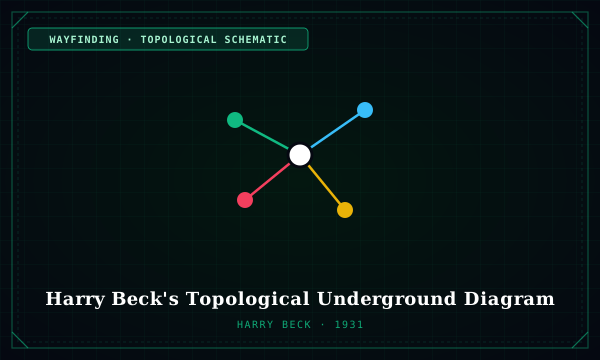
Topological Schematic·Formulator: Harry Beck·Year: 1931
Harry Beck's Topological Underground Diagram
COGNITIVE SCHEMATIC · HARRY-BECK-TUBE-MAP
"The 1931 electrical circuit revolution that decoupled public transit navigation from surface geography"
An engineering draughtsman for London Underground, Harry Beck realized passengers underground didn't care about true geographic distance or curved tracks—they cared about station sequence and interchange connections. He drew the map like an electrical circuit diagram using only 45° and 90° angles and evenly spaced stations.
Key Structural Primitives
Octolinear Grid
All lines restricted strictly to horizontal, vertical, or 45-degree diagonal axes.
Topological Invariance
Preserves station sequence and adjacency relationships while distorting physical distance.
Interchange Diamonds/Rings
Distinct symbols for transfer points, simplifying multi-line navigation.
Expanded Central Core
Central London stations enlarged for readability; outer suburban lines compressed.
Spatial Philosophy & Human Perception
"When navigating a subterranean network, topological connectivity is vastly more important than Euclidean metric truth."
Interdisciplinary Cognitive Links
The Chromologium (Color Physics)PIONEERS
Transit Color Line Distinction Ratios
Differential TopologyCOMPUTES
Graph Adjacency Topological Invariance
Canonical Text: Garland, K. (1994)