
Return to Wayfinding & Psychogeography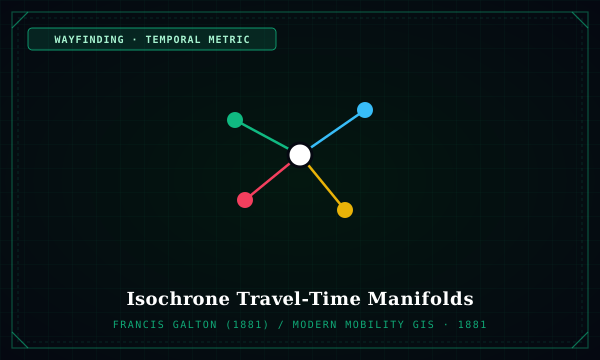
Temporal Metric·Formulator: Francis Galton (1881) / Modern Mobility GIS·Year: 1881
Isochrone Travel-Time Manifolds
COGNITIVE SCHEMATIC · ISOCHRONE-TRAVEL-MANIFOLDS
"Re-mapping the globe where distance is measured in travel minutes rather than physical kilometers"
In 1881, Francis Galton published the first global 'Isochronic Passage Chart' from London, coloring the world by how many days it took to reach each region. In modern urban planning, isochrones reveal the true 15-minute city access catchment area by foot, bicycle, or transit.
Key Structural Primitives
Travel-Time Contours
Concentric polygon contours connecting points reachable within equal travel times (e.g. 15, 30, 45 mins).
Multi-Modal Graph Routing
Combines pedestrian walking networks, GTFS transit timetables, and traffic congestion data.
Spatial Inequity Detection
Identifies transit deserts where geographically close neighborhoods are temporally isolated.
Spatial Philosophy & Human Perception
"Physical distance is an illusion; lived human opportunity is defined strictly by the temporal travel manifold."
Interdisciplinary Cognitive Links
Territorial IntelligenceQUANTIFIES
Transit Desert Resource Equity
Differential TopologyCOMPUTES
Multi-Modal Vector Graph Cost Surfaces
Canonical Text: Galton, F. (1881)