

Return to Wayfinding & Psychogeography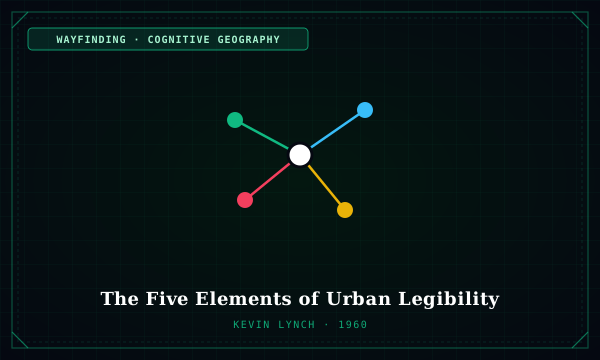
Cognitive Geography·Formulator: Kevin Lynch·Year: 1960
The Five Elements of Urban Legibility
COGNITIVE SCHEMATIC · KEVIN-LYNCH-ELEMENTS
"The foundational model of how humans construct cognitive mental maps of cities"
In *The Image of the City* (1960), MIT urban planner Kevin Lynch conducted mental-mapping interviews across Boston, Jersey City, and Los Angeles, demonstrating that mental maps coalesce around five universal structural primitives.
Key Structural Primitives
Paths
Channels along which the observer moves (streets, transit tracks, walkways, canals).
Edges
Linear boundaries not used as paths (walls, shorelines, railway cuts, highway trenches).
Districts
Medium-to-large two-dimensional city sections recognized by common identity or character.
Nodes
Strategic focal junctions where paths intersect or where intensive activity concentrates (plazas, transit hubs).
Landmarks
Point-references viewed from afar (spires, towers, domes, unique facades).
Spatial Philosophy & Human Perception
"A legible city allows inhabitants to navigate effortlessly and build emotional security through clear environmental orientation."
Interdisciplinary Cognitive Links
Game Geometry & MechanicsINFORMS
Open World Landmark & Path Design
The Chromologium (Color Physics)STRUCTURES
Wayfinding Visual Hierarchy Tokens
Canonical Text: Lynch, K. (1960)